Lai Administration Shifts from "Resist China to Protect Taiwan" to "Resist China to Protect Japan"
United Daily News Commentary, November 23, 2025
A recent comment by Prime Minister Sanae Takaichi of Japan, asserting that “a contingency in Taiwan is a contingency for Japan,” once again pushed China–Japan relations into turbulence. Beijing expressed displeasure, diplomatic friction escalated, travel advisories and military exercises were issued in parallel, and the situation intensified rapidly. Yet at this sensitive moment, many Democratic Progressive Party (DPP) politicians voiced strong support for Japan. However, the Ministry of Foreign Affairs (MOFA) clearly stated in its report that Ms. Takaichi’s parliamentary response cannot yet be interpreted as “Japan will assist in the defense of Taiwan.” Still, the DPP administration continues to convey goodwill toward Japan. What lies behind this strategic gesture? Or is it merely an instinctive political reaction from the DPP administration?
Amid strained China–Japan relations, MOFA was invited to deliver a briefing at the Legislative Yuan. MOFA noted that Ms. Takaichi, speaking as prime minister inside the Diet, made relatively explicit remarks regarding the so-called “Taiwan contingency,” seemingly intending to enhance deterrence against China. Yet to this day, the Japanese government continues to maintain “strategic ambiguity” on the issue of a Taiwan emergency. Regarding whether such a situation would constitute a “survival-threatening crisis,” Tokyo consistently states that it must “be judged comprehensively based on individual circumstances, and cannot be generalized.” Since Japan has not given a clear response, Ms. Takaichi’s recent statements cannot be directly interpreted as “Japan will come to Taiwan’s defense.”
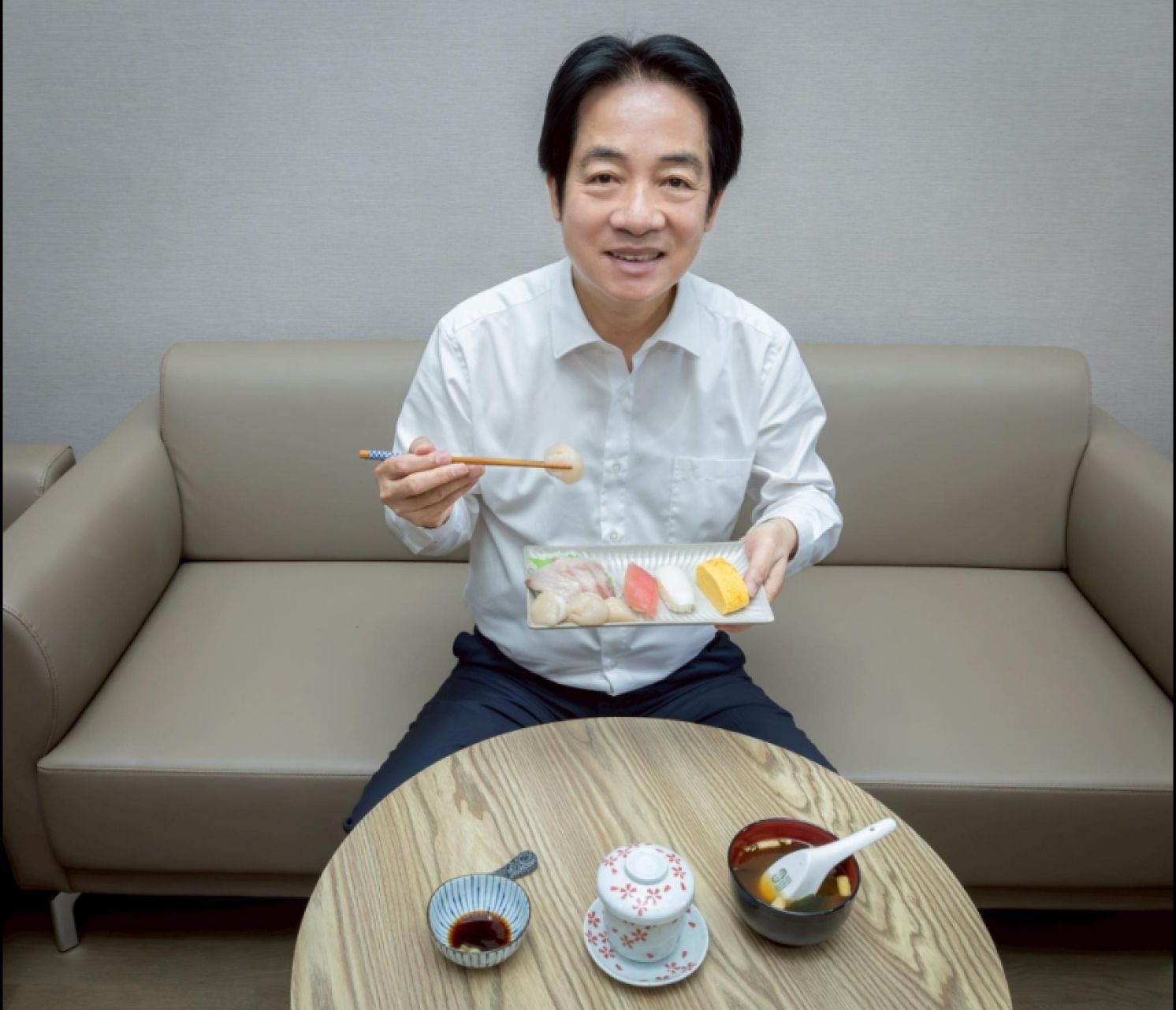
Nonetheless, President Lai Ching-te posted on social media, emphasizing that “today’s lunch was sushi and miso soup,” highlighting amberjack from Kagoshima and scallops from Hokkaido. Following the president’s display of consuming Japanese marine products, several DPP legislators likewise showcased their enjoyment of Japanese apples, persimmons, and tangerines, while encouraging the public to travel to Japan and urging people to show support through concrete actions.
The DPP administration’s active pro-Japan stance is, of course, driven primarily by the fact that Beijing is currently pressuring Japan. Taiwan has long endured China’s economic and diplomatic coercion. Facing a similar authoritarian threat, Taiwan naturally finds emotional and value-based affinity with Japan. However, from Beijing’s perspective, what it sees is Taiwan and Japan standing on the same front—an alarming signal that heightens risk. If Taiwan overstates its position, then it may not only fail to help Japan but may also lead Beijing to perceive Taiwan as an extended battlefield of China–Japan confrontation.
Taiwan could, like other countries friendly toward Japan, simply regard Japan as a key partner for regional security, while avoiding being dragged into the geopolitical whirlpool of East Asia. Taiwan should take this as a guiding principle rather than reducing its posture to emotional “Japan-supporting” sentiment or politically driven “pro-Japan” symbolism.
What is most concerning is the potential for the ruling DPP to frame the current China–Japan friction as a new iteration of “resisting China to protect Taiwan,” or even twist it into a narrative of “resisting China to protect Japan,” using Taiwan’s support for Japan as a political tool. When friendly relations with Japan are packaged as political rhetoric, and when geopolitical risk assessment loses rational and professional judgment, the outcome can shift toward emotional and ideological confrontation. Pursuing political points in this manner could ultimately expose Taiwan to even greater geopolitical danger—a wholly irresponsible approach.
Taiwan’s government has the right to express its stance and must safeguard its relationship with Japan. Yet when regional tensions rise, diplomacy is not a contest of who shouts louder; it is a matter of knowing when to speak and when to pause. Facing escalating tensions between mainland China and Japan, Taiwan must carefully avoid provocation, treating every statement and action as a precise diplomatic maneuver rather than a political performance.
From: https://vip.udn.com/vip/story/122365/9157172?from=vipudn_maincate_latest